Archive for the 'travel' Category

Technicolor Mumbai

Posted by Bambi on Mar 10 2010 | travel

Morning in Colaba, Mumbai

7:00 a.m. in the Colaba Market area, where life is lived outdoors as much as in. Residents were just beginning their day. Someone was asleep on a handcart under a cloth. Others slept on the ground, on palanquins, on steps. A man stood in the road brushing his teeth vigorously with his finger. A boy sat among his goats, which nuzzled and cuddled him. Men and women arranged technicolor produce in baskets, for sale. Handcarts rushed by in every direction.

A live chicken seller in Colaba, Mumbai

A chicken truck squeezed through the narrow lane, carrying seven stories of live caged birds. The driver hung a scale from the back of the truck and extracted a fistful of chickens—that is, a fistful of their legs. They hung upside down like a giant flapping pompom as the murgh-walla tied the bundle of legs and hooked the now calm birds on his scale. A customer, or perhaps he was a delivery-man, threw three large bundles over his shoulder against his filthy shirt.

Banana delivery truck in Colaba, Mumbai

Around the corner, a banana truck unloaded huge stalks of green bananas onto the shoulders of runners. An old, frail man came back again and again, each time carrying three massive stalks stacked on his left shoulder, while a larger, younger man carried two stalks.

Cats, dogs, goats and babies played in the dust and litter. Bob and I were ignored, or greeted with smiles and waves. Several residents directed us to some nearby point to see the sea. We wandered off in that direction, leaving the wide street of multi-story buildings. We wound through labyrinthine alleys of rickety dwellings and make-shift shelters of scraps and tarps. Customers were already seated in an open-air barber shop, a tailor measured and cut cloth, and a man pressed trousers with an antique iron full of glowing coals.

Colaba ironing service

As we approached the sea, the dusty ground became black muck. A gang of small boys ran around us with squirt guns. “Water shower!” one shouted, as he fired a stream into the air. Old wooden boats lined the route to the bay, tilting in the mud, weeds growing through their broken bottoms. Black crows perched on their structures, surveying the garbage strewn about. The stench was overpowering. It became clear to me that we had entered a dump. A few lone men and boys passed us, walking through the putrid sludge toward the water. I hurried forward, eager to get past the fetter—until I caught sight of the view.

Colaba slum area

A hundred small boats lay bobbing on the still water of the bay, colorless and silvery against the white morning light. Across the bay, an easy walk away, the red dome and new tower of the Taj Mahal Hotel rose in stark contrast to trash-strewn beach at my feet. I was transfixed by the disparity, and began taking pictures. Crows cawed and little waves splashed against the rocky shore.

Suddenly I noticed the few men here and there on the beach and at the water’s edge. I was staring at their toilet. Appalled and mortified, I hurried away. Bob followed. We cut through a low part of the slum instead of retracing our path. It was neat and organized, with muddy but clean paths. The friendly smiles of women and children just starting their day helped me recover from my shameful, insensitive behavior. A tiny girl ran behind me calling “auntie! auntie!” When I turned, the child game me a huge grin. “Happy Holi,” she said, giving us a useful phrase that made everyone smile.

Colaba Holi

Holi is India’s spring festival of colors, a day on which people get wild and crazy and throw colors in the form of powdered dye.

Another day, after a fabulous meal at Soam, we walked the few blocks to the north end of Chowpatty Beach and began to walk south around the huge crescent of sand packed with people. A tiny naked boy ran up to us, hand out. He was filthy and gorgeous, and trotted along side us with bouncy little steps. He couldn’t have been more than five years old.

Mumbai boy

We tried to ignore him, afraid he’d get lost following us so far. I wondered if he had a mother, and how such a young child could be allowed to run loose and barefoot through dangerous traffic. Did he have anyone to care for him? I wondered what he’d do if I scooped him up, washed him, and fed him. Would he eventually feel a need to go back “home”? Did he have a home? Would he know how to find it? Or would he be content to stay with strangers who took good care of him? Then I wondered how the Indian government would react if I said I wanted to take him home and provide for him.

I was sad when the little boy finally left us. I worried about him finding his way back. But maybe “back” was just a point—the spot where he found us, with no other significance. Maybe he has no place at all; he sleeps where he is when he gets tired. I saw quite a few children asleep in strange places. One boy of three or four was sprawled across the middle of a busy sidewalk. That he hadn’t been trampled seemed a miracle.

Later, a former police officer from Mumbai told me that the boy definitely had someone watching him, and that he’d been sent to beg. At least his perfect little body hadn’t been maimed for “professional” advantage.

Mumbai sidewalk tattoo

A huddle of people sat on the sidewalk at the edge of the beach. A woman was tattooing the arm of her customer. A boy held together a stack of D cell batteries from which a pair of wires connected to the buzzing tattoo gun.

Bob and I saw less misery in the streets of Mumbai compared to previous visits. We saw fewer people sleeping in the open, and far fewer beggars. On arrival at Mumbai airport, visitors used to be circled by aggressive beggars the moment they stepped outside. That situation no longer exists. Police told us the city is able to feed many street children, but that it’s an enormous financial drain.

This visit, I saw very little street food outside of officially regulated restaurants. Bhel puri, the famous Chowpatty Beach snack, used to be made à la minute at carts on every corner. Trucks and taxis do much less horn-honking now. Restaurants are smoke-free.

Mumbai family

Our cool and quiet hotel was right off the hectic Colaba Causeway. A table in the lobby held two thermos pitchers, one of sweet chai, one of arabic coffee. Between them was a small water-filled bowl in which four tiny glasses were submerged. As the day went by, the water got cloudy and murky. The water (and glasses?) were occasionally freshened.

Teacups

More soon on street crime in Mumbai.
More soon on food in Mumbai.
© Copyright 2008-2010 Bambi Vincent. All rights reserved.

2 comments for now

More airport luggage theft

Posted by Bambi on Feb 19 2010 | thieves, travel

Sabrina Zotter, alleged luggage thief in Phoenix

Sabrina Zotter, alleged luggage thief in Phoenix

Imagine the post office delivering your mail to a big open heap, mixed with the envelopes and boxes of 300 strangers. The honor-based system would have you pawing through the pile and taking just what’s yours. No one would guard the items; no one would check who took what.

Why not? The airlines do it. Nowadays, we even pay for that flawed, partial delivery system.

Theft of luggage from airport baggage carousels is too easy. Yet another bag thief has been arrested for stealing luggage out of Phoenix Sky Harbor International Airport. Excuse me—”suspected” bag thief. Phoenix Police say she’s been under surveillance since last September. I’m sure Zotter’s not the only baggage thief operating. Neither is Phoenix the only airport we need to worry about, though it may be particularly easy for thieves.

I wrote about luggage theft at Las Vegas McCarran Airport here, and about European and African airport thieves here.

Thief “JD” only pretends to steal luggage at baggage carousels. That’s his way of distracting tired travelers in order to get their wallets. “Right now, I can go to McCarran airport and go to baggage claim and beat some stings,” he says. “Because security is, evidently, lax, and the people are rushing to get their bags, and the bags are coming off the trolley. And when he’s stooping down to get his luggage— ‘Oh, is that mine, sir?’ Shake him up. ‘Oh, is this mine? It looks like mine.’ If you’re moving, and I got someone with me, and you’re in the airport, I’m going to play you. If I feel like I can work you I’m going to play you.”

I fly into Phoenix frequently, and into Las Vegas several times a month. Since bag tag checkers were removed ages ago, I’ve never seen any security at either airport.

Airlines are blamed for a tremendous amount of lost luggage. How often are they, too, the victims of these baggage thieves? It would be in their interest to band together and pay for a little security at the baggage carousels.

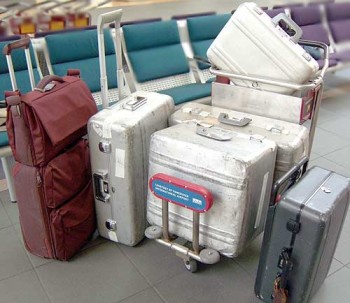
airport baggage carousel
© Copyright 2008-2010 Bambi Vincent. All rights reserved.

no comments for now

Confronting muggers in Panama

Posted by Bambi on Feb 11 2010 | Bob Arno, thieves, travel

A dangerous street in Colon.

“You look like a million dallahs,” the mugger leers at Bob Arno, his gold teeth glinting in the Panamanian sun. The dozen or so men who’d gathered around us nod and elbow one another.

Bob wears a polyester t-shirt over nylon shorts; acceptable on the tennis court, but otherwise, pretty shabby attire. He wears no jewelry, but his Cole Haan sneakers are pretty snappy. Is that it? The shoes? Or is it the pricey equipment he carries—a sleek video recorder and separate audio recorder?

When we find these gangsters, they appear to be defending their turf.

When we find these gangsters, they appear to be defending their turf.

The mugger wears a spotless white t-shirt over a white wife-beater. Fancy, gold-accented sunglasses perch in his short hair. On his wrist, a circa 60s gold watch worth about a thou, give or take. A gangster with a flare for making just the right statement.

Our translator, Gustavo, chuckles nervously, though he’d assured us we were safe with him. As a former gangster himself, he knows, presumably, where his alliances lie. Which is not everywhere, as he was reluctant to walk with us down a street he deemed too dangerous, though it looked much like this street.

Colon gang leader Enrique

Colon gang leader Enrique

Enrique, the mugger Bob and I are chatting up, is said to be the baddest of the bad guys. He also seems to be the smartest—and a take-charge kind of man. We started out talking to his fellow gangster Gilberto, but Enrique quickly took over, eagerly answering our questions. As if he really wants us to know what life is like for him and his neighbors.

No one in the neighborhood works, because there isn’t any work. Occasionally, a few of the men will get jobs on construction sites. Even Enrique. But the money from those jobs only lasts so long, and the men need money for their families. So they rob. They steal. They mug.

It’s simply the way of life in this part of Colon. Nothing to be ashamed of, nothing to hide from the children. In fact, we’re surrounded by children of every age as we question Enrique and Gilberto. Dozens of children.

Seeking a little privacy, we move the two gangsters and our translator to a nearby alley, but others follow, curious.

Seeking a little privacy, we move the two gangsters and our translator to a nearby alley, but others follow, curious.

We’d started the interview by moving into a wide alley for privacy, where laundry flutters over a junked car. One by one and two by two, a crowd gathers. Mostly other adult men and small children, while women hang over balconies and push aside curtains at windows on the alley.

We’re in the heart of gangland. Brave and maybe stupid, we’re out of our water. At a shrill whistle, I break into a cold sweat. Fifty rival gangs patrol Colon; violence could erupt at any moment. Three a week are killed, we’re told, in gang fights. Three a week—wow.

I’m smiling till my cheeks hurt and my lips crack. Bob and I do a lot of smiling, mostly with the intent of disarming the thugs. We’re full of false confidence, hoping they can’t smell our fear. A defenseless city couple holding tasty electronic goodies like fish out of water. Like lost wildebeest surrounded by lions hiding in the grass.

People watch us from balconies all around us. Some dance. Quite a few men hold babies.

People watch us from balconies all around us. Some dance. Quite a few men hold babies.

Like the rest of us, Enrique heads to the bank when he needs cash. But that’s where our methods differ. He lingers outside and waits for a flush customer to come out. He uses a gun when he needs to. The problem with robbing bank customers is the police, who tend to watch out for men like Enrique. So his second choice is robbing drug dealers, an activity fraught with deadlier dangers: the drug dealers carry guns. Oh, and there’s the odd tourist who wanders through town.

Enrique is clean-cut and thoughtful-looking, with a nice face. You can barely see the gangster tats peeking out of his t-shirt. He doesn’t look like a mugger, whatever a mugger is supposed to look like. He doesn’t look like the heartless, dangerous man he really is. Neither does Gilberto, a younger man with sad, wistful, distant eyes.

Bob Arno and Gilberto

Bob Arno and Gilberto

Maybe this is unique to the Panamanian underworld. Angel, the pickpocket from Panama City, looks sweet but clueless. His pal Jaime has intelligent eyes in a handsome face. Both Dajanel and Jael, violent muggers in Colon, have faces you could put on a Disney badge. Even our translator Gustavo, granted, a former gangster, is positively radiant. My impression of Panamanian thieves does not include greed as an attribute. Nor do those I’ve met seem to be drug users or dealers. They just want enough to survive.

Children surround Bob and the men on the trunk of the car.

As Bob fires questions at Enrique and Gilberto, I marvel at the liveliness of the neighborhood. Music blasts from several sources. Girls on the street and on balconies dance to different beats. Six small children are now perched on the trunk of the parked car, beside and between Bob, Gilberto, and another man. They tap their fingers and toes to music as they listen to their fathers and uncles describe how they pull guns on people to get money.

Everybody's got a handgun in his pocket.

Everybody's got a handgun in his pocket.

A handgun is suddenly pulled from a pocket and it startles me. The children who’d climbed up on the car are four to eight years old, but the gun is obviously nothing new to them. The point is, everybody’s got a gun in his pocket, even though it means five years in prison if they’re caught with one.

I ask Enrique if he mugs women. He hesitates, then looks embarrassed when he says yes. If her purse looks heavy, if she looks like she’s got money, he’ll mug a woman. There’s no respect. It’s all about the money.

Across the street from our interview, another decaying building alive with people.

Across the street from our interview, another decaying building alive with people.

Gustavo finally eludes to his criminal past and prison term. No surprise. He belongs to the government-sponsored company of former gangsters turned tourist guides. His work, when he gets it, usually consists of taking tourists out to the Gatun Locks in the Canal, or to the mall, or to beaches. He’s paid $23 for each day he works, usually two days a week.

Gustavo is decidedly beefier than his gangster pals, and I guess it has to do with his steady income, meager though it is. Later, Gustavo introduced us to yet another former gangster, now a respected office worker for the department of immigration. He has both an email address and a fat belly—signs of success. We also meet a few people wearing braces on their teeth. How can they afford it?, I ask Gustavo. They don’t need braces, he scoffs. It’s just a fashion.

It's disconcerting to be completely encircled by curious onlookers in a neighborhood like this one.

It's disconcerting to be completely encircled by curious onlookers in a neighborhood like this one.

By the time we finish our interviews, some 40 people have gathered round us. The adults stand quietly, politely, crowding in close. The children play, observe us, and mug for our cameras. No one scolds the little ones when they climb some rusty scaffold or run into the street. Tangles of razor wire dangle ominously, and sewers loom without grates. These are wimpy dangers in this neighborhood. Rival gangsters might come around the corner at any moment. The slightest infractions justify killing: You looked at my girlfriend. I want those shoes.

The kids loved watching themselves on video when we turned the screen toward them.

We hear a siren, but it’s probably the nearby fire station. The police only show up after gunfights, they tell us. They only come to pick up the bodies.

Colon kids cool off in a pool on a street corner.

Bob has more to say about muggers, Panama, and our experience there. Stay tuned.

© Copyright 2008-2010 Bambi Vincent. All rights reserved.

5 comments for now

Theft on a plane

Posted by Bambi on Jan 31 2010 | Travel Advisory, thieves, travel

JD, an American pickpocket

I'm not ready to out "JD" completely.

All this hearsay, lately, about pickpockets onboard airplanes. Even a celebrity-son helped himself to sleeping passengers’ valuables. Here’s what a thief told me, in pickpocket-lingo:

The Stick, the Shade, and the Wire

“JD” an American whiz player, travels to all the top sporting events in the United States. His favorite tool is a garment bag which he calls his shade, a prop to hide his theft of a sting, or a wallet. Dressed in a suit from the wardrobe he’s proud of, he flies to his destination penniless. He described his recent trip to Las Vegas.

“I made $900 coming out of the airport. When the plane lands, I start work. I got to get my money to get out of McCarran airport. Play strictly on skill, that’s how I play—on the plane. Yeah, plane lands, people have their arms up getting their bags. See my man, get up on him, pow, I spank him, off the front leg.

“It was a pappy—a man—right? He got a sting—a wallet—in the front slide, but he also got cash. I played this for his credit card. I got a guy with me we call a writer. He writes the work, writes the spreads. He’s a stick—what you call a stall, what we call a stickman writer. He’s stick and shade. I do the wire. The wire is the one who takes. We split up when we get on the plane, he gets in the back and I get in the front.

“Right now, I can go to McCarran airport and go to baggage claim and beat some stings. Because security is, evidently, lax, and the people are rushing to get their bags, and the bags are coming off the trolley, and I got my garment bag ….

“And when he’s stooping down to get his luggage— ‘Oh, is that mine, sir?’ Shake him up. ‘Oh, is this mine? It looks like mine.’ If you’re moving, and I got someone with me, and you’re in the airport, I’m going to play you. If I feel like I can work you I’m going to play you.

Excerpt from Travel Advisory: How to Avoid Thefts, Cons, and Street Scams
Chapter Three: Getting There—With all your Marbles

Airborne Victim

“Kayla,” a 15-year-old girl, told me how her wallet was stolen on a cross-country flight. Her mother and sister supported Kayla’s story. The thief was a 35ish woman sitting next to her. In the middle of the flight, the woman bent down and pretended to be digging in her purse. But Kayla felt something and looked, and could see that the woman was digging in her (Kayla’s) purse.

Kayla said she was too scared to say anything. The woman got up and went to the bathroom. Kayla checked her purse and found that her wallet was gone. She told her mother. Then she and her mother told a flight attendant. The flight attendant found the wallet in the bathroom, missing only Kayla’s cash. Kayla was still too afraid to say anything to the thief. When the plane landed, the woman just left.

Take Precautions

Is theft on planes a risk worth worrying about? I don’t think so. Then again, if you’re the unlucky victim of a flying filcher, you’ll be plenty pissed. If you sleep, that tiny possibility is there. Even if you don’t sleep, do you know what’s being rummaged above your head? On some planes, a thief could reach behind his feet to access the bag under his seat.

What to do? Just make it more difficult for the casual thief. Bury your valuables within your bags. Use little locks on your carry-ons. Put your bags in the bin zipper down, or with the opening to the back of the bin. (Yeah, I know, wheels in first, they say.) Use the bin across from you, so you have a chance of looking if someone opens it.

Do I do all those things? Nope. But I do enough to make my stuff more difficult to access than the next person’s.

If you’re a heavy sleeper, or like to close your eyes and disappear under earphones, as I do, there’s not much you can do short of sitting on your stuff. Still, I’d be more concerned at a sporting event or concert, than aboard an airplane. JD makes a great living stealing wallets from people in crowds. And he’s still out there.

© Copyright 2008-2010 Bambi Vincent. All rights reserved.

6 comments for now

Pickpockets in Durban, South Africa

Posted by Bambi on Jan 26 2010 | Bob Arno, Travel Advisory, thieves, travel

Mdubuzi, a pickpocket in Durban, South Africa, stole a wallet from a woman watching a car race. Bob stole it from Mdubuzi and returned it to the victim.

Mdubuzi, a pickpocket in Durban, South Africa, stole a wallet from a woman watching a car race. Bob stole it from Mdubuzi and returned it to the victim.

“We do what you do,” Bob told the poker-faced pickpocket. “Same job.”

Looking at his blank expression, it wasn’t clear that he understood. Perhaps he didn’t speak English. If he did understand, his mind must have been racing. What could be worse for a pickpocket than being confronted by a stranger? Even one who claims to be a colleague.

“Here, I’ll show you.” Bob put his hand on the young man’s shoulder, dipped into the man’s pants pocket, and extracted a woman’s wallet—the same one we’d just watched—and filmed—the pickpocket snag from someone’s handbag.

Bob opened the wallet. There was no money in it. The pickpocket watched in stunned silence as Bob turned away with it.

“Excuse me, madam. Is this yours?” Bob offered the empty wallet to the victim who still stood just a few yards away, engaged in the spectacle she’d come to witness. The woman accepted the wallet gratefully, but puzzled. She hadn’t realized it was missing.

“You see?” Bob asked, returning to the pickpocket. “Same job. You understand?”

“I understand.” the young man said. Clearly, he didn’t know what was coming. Best to say little, he seemed to think. Speak only when questioned.

It was our first visit to Durban in many years. The climate had changed drastically since the abolishment of apartheid and the switch in governments. Violent crime in South Africa was frighteningly high now, to the extent that the U.S. State Department, as well as Britain’s and Australia’s governments, recommended that business travelers to the country employ armed bodyguards.

Visitors were warned to stay in their hotels after dark and use extreme caution at all times.

Mdubuzi uses stealth to steal from women’s purses, his forte.

Mdubuzi uses stealth to steal from women’s purses, his forte.

It was a warm spring Sunday when Bob and I landed in Durban’s city center. We had intended to wander through the outdoor market when our attention was drawn to a huge crowd on the edge of Central Park. Though we couldn’t see beyond the spectators, roaring engines soon informed us that they were watching car races. We hung back a bit and studied the rapt audience.

“Watch those three,” Bob said, and I followed his eyes. “Watch their body language.”

Within two minutes of our arrival, our eyes were fixed on a trio of suspicious characters. These three did not strain to look over or between the heads of the crowd. They seemed to be as interested in car races as Bob and I were. Instead, they looked at the backs of the spectators. They lingered and loitered a few minutes, then moved on and looked for new opportunities among new backsides.

Engines roared and tires squealed. Loudspeakers blared some exciting results. One of the young men had a plastic shopping bag in his hand; as in fact, many people did. But his bag was folded flat in half twice, which gave it a bit of firmness. It could have contained a greeting card, or a small pad of paper. On closer inspection, I noticed the red advertising copy printed on the bag was worn off to the point of illegibility. The folded bag must have been held in a sweaty grip for hours.

Three pickpockets surround a woman spectator at a car race.

Three pickpockets surround a woman spectator at a car race.

The three men positioned themselves around a woman whose purse stuck out behind her. One man moved in on each side of the woman, blocking her purse from the views of anyone to her sides. The third man slowly crowded into the woman from behind, stretching his neck as if trying to watch the race. Slowly, slowly, his left hand raised the flattened bag to the purse, where his right hand crept up to meet it. Then, with the plastic bag as a shield and his right hand poised above the purse, he gave the woman a little jostle. A gentle, natural jostle, appropriate for a tightly crowded audience engrossed in vicarious thrills. His skinny elbow raised and lowered then, and Bob and I caught a quick glimpse of brown leather before it was folded into the flattened bag and plunged into the thief’s deep pants pocket.

Excerpt from Travel Advisory: How to Avoid Thefts, Cons, and Street Scams
Chapter Five: Rip-offs: Introducing… The Opportunist

© Copyright 2008-2010 Bambi Vincent. All rights reserved.

1 comment for now

Hotel Oddity #7

Posted by Bambi on Jan 12 2010 | travel

resesh-1

What’s that spray bottle hanging in the closet of our Tokyo hotel room? It wears a gold necklace from which its explanation dangles.

“Resesh” is a fabric freshener with green tea to remove unpleasant odors from your room and clothes.

Sniff, sniff… does my room stink?

Refresh with Resesh.

Uh…no thanks.

.

resesh-2

© Copyright 2008-2009 Bambi Vincent. All rights reserved.

2 comments for now

Mugged in Mumbai

Posted by Bambi on Jan 06 2010 | Guest post, thieves, travel

Cruise director Paul McFarland

Cruise director Paul McFarland

“I WANT,” is the driving force behind mugging: need and greed. But these muggers in India also had intangible desires that compelled them to behave in a way that surprised their victim. After a recent visit to Mumbai, my friend Paul McFarland, a cruise director, filed his report.

Thanking Muggers

After years of travel there are a few places that I still get excited to visit. Mumbai, India is one of them.

After a delicious meal at the Khyber restaurant, I waited for a taxi outside. I planned to go to Victoria Station, the train station in downtown Mumbai, to take photos of the beautiful building and the colorful people.

A black and yellow taxi pulled up, reminding me of a bumblebee; not so much because of the color but because of its size. It took me some time to fold my 6’ 3” frame into the back of the vintage vehicle, and I was no sooner in when the driver hastily sped off. We quickly reached top speed and began cutting and slashing through the traffic. I felt like a bag of rice being thrown from side to side. Fortunately my outstretched arms could reach each side of the vehicle and that alone kept me upright.

The driver sensed my discomfort and asked if I liked Indian music—as if that would soothe me. I didn’t want to set him off by saying no, so I nodded. Big mistake. His voice sounded like a snake charmer’s flute as he sang, and he let go of the steering wheel, wildly waving his arms as if he were a classical dancer. All the while he was driving faster and faster, narrowly missing ox carts, cars, and pedestrians. I finally screamed at him to slow down, whereupon he glanced at me in disbelief and started to sing his song slower. The good news is that I arrived at Victoria Station in record time. Little did I know this was just the start of my adventure.

I got out of the taxi much quicker than I got in—so happy I had arrived safely that I gladly overpaid him by 200 rupees. I had plenty of money with me as I planned on giving a few rupees to some of the people as a thank you for allowing me to take their pictures.

Mumbai fruitwalla near Victoria Station

Mumbai fruitwalla near Victoria Station

Victoria Station loomed large across the busy intersection and beckoned to me to photograph its architectural beauty.

On the way I stopped every few feet to photograph the colorful, happy people at the markets that had sprung up on the streets surrounding the station. They were selling everything: from watermelon with slices of fresh pineapple chilled with melting blocks of ice, to scraps of material, to cheap padlocks. Because my camera was new I was concentrating on the viewfinder, focused solely on my photography. I wandered freely throughout the crowded market and, even though I was by myself, I felt very safe. I’ve enjoyed many wonderful visits to this exotic and exciting country without any incidents and had no reason to believe today would be any different.

Even though I didn’t buy anything, the street vendors seemed to enjoy having me look at their items. I think it added some credibility to their card-table stores. I weaved my way through the vendors and crossed the street to capture a good panoramic view of Victoria Station. As I walked along a roadside barrier, I kept my eye on the building.

I didn’t notice a taxi approach me from the opposite direction. It pulled to a stop right next to me and two young men got out. At the same time someone tapped me on my shoulder. As I turned to see who it was, the two men from the taxi immediately dropped down in front of me, grabbing and wrapping themselves around each leg.

My first thought was, my God these beggars are a lot more aggressive than they used to be; but at the same time two men jumped on my back, one holding onto my left arm and the other one going for my backpack which contained more camera equipment. Another one wrapped his arms around my waist. I must be watching too much of the Discovery Channel because I remember thinking: I’m like a wildebeest on the Serengeti being pulled down by a pack of jackals. Even though the wildebeest is much stronger, the jackals can bring him down through perseverance.

I staggered forward wearing five young men. Then it occurred to me that they weren’t trying to hurt me, they were just trying to detain me long enough to pick my pockets. Within seconds I reached for my wallet but it was it was already gone. This enraged me and I tossed two of the young men to the ground. But I noticed at the same time that one of the boys was running from the scene dodging traffic as quickly as his flip-flops would allow. His hasty departure told me he was the one with my wallet.

I tried to pursue him, but there were still three thugs hanging onto my legs and waist. I was able to quickly rid myself of the young man around my waist but I had to use my camera as a hammer to get rid of the human leg irons. They were no match for the Nikon D300 and dropped off. Then I was free to pursue the thief with my wallet.

I ran across the four lanes of traffic yelling stop thief at the top of my lungs, hoping to gain attention and support from the many locals in the area. But he had already made it to the other side of the road and had merged with the millions of Indians at the Sunday market. My heart sank, knowing that my chances of ever seeing him or my wallet again were nil.

Sidewalk barbers in Bombay

Sidewalk barbers in Bombay

I wandered through the market, carefully scrutinizing every face I saw. After about ten minutes, realizing my search was futile, I headed back to the road. I now looked suspiciously at the same people, and now their beauty and innocence were gone. I was sad about that. Little did I know that there was still more to my adventure.

The black and yellow bumblebee taxis were all lined up looking for fares, but not necessarily looking for me because, in this part of town, few of the drivers spoke English. In these situations, rather than asking drivers if they speak English I ask “Did it snow last night?” if they say “yes, no problem,” I know we’d have a problem if I got in that taxi.

After quizzing eight to ten drivers, I found one I thought understood my destination. I was relieved that I had remembered before leaving the ship to stash some cash in other pockets in case of just such an emergency. I climbed into the taxi and he took off in the direction of my ship, giving me confidence that I had made the right choice.

We’d been on the road for three or four minutes, giving me time to organize my thoughts and do a mental inventory of what was in my wallet and what steps I was going to have to take when I got back to the ship. I realized that the wallet contained three credit cards, my drivers license, my PADI dive card I’d had since 1976, and $250 cash.

My concentration was interrupted when suddenly another taxi pulled up next to us with two young men in the back seat yelling at my driver. My driver tried to ignore them at first, but eventually was forced to the side of the road by the other taxi. I couldn’t believe it was happening again, and I braced myself for another attack. I thought: the bastards know I have more money because I got in a taxi and they’re after every penny.

I gripped my Nikon for action as the two young men jumped out and quickly threw something in the back window that landed on my lap. Thinking the worst, I threw myself out of its path—only to discover that it was my wallet. To say I was surprised to see it is an understatement. I opened it and realized that my credit cards and everything but my money was intact.

As they fled, I was so relieved, I blurted out the window, “thank you,” as if they were India’s version of Robin Hood. I thought: you’ve really lost it now—thanking muggers! My taxi driver smiled at me, and we once again took off for the port. On the ride I double and triple check my wallet, thinking it was too good to be true to have thieves go to the effort to track me down. Why had they chosen me to attack, and then why in the world would they take the chance of being caught by returning it?

Musicians in Colaba, a Bombay neighborhood

Musicians in Colaba, a Bombay neighborhood

I wasn’t sure if my driver knew that I’d been mugged when I got in the taxi, but I was pretty sure he figured it out. So I asked him why they returned my wallet and he gave me in a one-word reply: Karma. I remembered reading that in the Hindu and Buddhist religions Karma is most important and is based on actions or deeds. The thieves initially created very bad Karma for themselves, but by returning my wallet perhaps they hoped to balance it out with a good deed.

Once back at the port I told the ship’s agent about the incident and he asked me to describe the attackers. I told him that there were six or seven of them, and that they were all about 5’ 6” to 5’ 7” with dark hair and dark complexions. I added what I thought would be a helpful detail, remembering that they all wore flip-flops. He seemed amused, and I embarrassingly realized that I had just described not only my attackers, but probably five million other young men in the city. I quickly added that one of them might have a unique imprint on his forehead—that of a 28 x 200mm Nikon lens.

Bottom line: I lost $250 but that’s not what I’ll miss the most. I’ll miss feeling safe in a city I still love.

*
The photos of Mumbai are mine. Paul’s are probably much better!
• For more on muggers, read
“How I mug,” as told by two muggers in Panama

1 comment for now

Hotel oddity #6

Posted by Bambi on Jan 01 2010 | security, travel

The useless chain latch in my room at Miami's Radisson Mart Plaza Hotel.

The useless chain latch in my room at Miami's Radisson Mart Plaza Hotel.

See anything wrong with the chain lock on this door at Miami’s Radisson Mart Plaza Hotel? It’s mounted backwards! Upside-down. It’s useless this way and, worse, gives a false sense of security. Another serious security risk.

Do all the rooms have useless chain latches, or only our room, 612? A polite letter to management brought only a generic “We appreciate your recent message.”

door-chain-upsidedown

4 comments for now

Mac + paperclip = fire

Posted by Bambi on Dec 27 2009 | Misc., travel

The adorable, 16-pound baby.

The adorable, 16-pound baby.

Anyone remember this old relic?

We were so thrilled with it. We’d spent a year in Africa and needed a laptop. Apple didn’t make one yet, so we had to buy a DOS machine. Shortly after we got home, Apple came out with a luggable.

Bob and I were on a cruise ship with our Mac Portable. The machine was a year or so old—that’s how long ago this was. Bob sat at the desk in our stateroom, I on the bed, with my 16-pound Mac open in front of me.

“Pass me a paperclip,” I said to him.

Apple logo circa 1989.

Apple logo circa 1989.

He tossed, I missed. The paperclip fell right into a narrow gap behind the display, where the back end of that computer extended another four or so inches. Instantly, a thin wisp of smoke arose and, like a cartoon, curled its wavy way right up to the smoke detector. On a ship. At sea.

I gave the gap a good blow and was horrified to see a little red flame dancing within. We got the tiny fire out quickly, but the machine was dead.

The size of a small suitcase.

The size of a small suitcase.

The story’s not over though. We had a fancy neoprene case for the Mac Portable, embossed with a pretty little Apple logo. On our way home, we bought extra insurance for the case and sent it as baggage—something we’d otherwise never do. We hoped it would be stolen. We were sure it would be.

Not a reflection. Handle, display, hinge, back end.

Not a reflection. Handle, display, hinge, back end.

On arrival, we waited at the baggage carousel—and waited. Finally, we went to the lost luggage office to report the loss of our insured computer. “Oh, we have your bag,” they said. It got extra care since it was insured, and they wanted to hand it to us personally. (Yeah. Those were the days.)

I found the old Portable in the garage recently. It has some parts tucked into its case I don’t remember, like a huge battery brick. Though it doesn’t start up, I can’t throw it out. I don’t know why.

paperclip

© Copyright 2008-2009 Bambi Vincent. All rights reserved.

3 comments for now

Hotel room safe thefts

Posted by Bambi on Dec 22 2009 | security, social engineering, thieves, travel

safe-keypad

How safe is the safe in your hotel room? Not safe at all, it turns out, unless you factor in the odds. Odds are, your safe won’t be broken into. But the fact is, the crackin’s easy. Of course it is—hotels must be able to rescue valuables from faulty memories (forgotten codes, departed guests who forgot to empty their safes), lost keys, dead batteries, and power outages.

Hotel management and/or security can always access room safes. But how? Depends on the kind of safe. Does it open with a metal key? By swiping a magnetic card, or punching in a code? Does it use a plastic key card with a pattern of holes punched in it?

A hotel in Palma de Mallorca, Spain.

A hotel in Palma de Mallorca, Spain.

Bob and I have long endorsed the use of safes in hotel rooms, as long as they are electronic. We’ve shied away from metal- and plastic-key safes, concerned about how many copies float around. But there are other ways to enter safes, and an untold number of people who have access, authorized or otherwise.

A deluge of thefts from hotel room safes in Palma de Mallorca, Spain, led to an investigative report by Burkhard Kress for Extra, a news show on German RTL TV (unfortunately not online).

Hidden camera captures master override code.

Hidden camera captures master override code.

Kress booked a room there and mounted a hidden camera, then called hotel management for help opening his safe. The hidden camera footage captured the code that management punched into the safe’s keypad, which ended with the room number. With the permission of the guest in the room next to his, Kress tried the same code appended with the other room number. The neighbor’s safe opened. Anyone with the master code could open every safe in the hotel.

And anyone with a hidden camera could capture the master code.

These three, who shared a room, called police when they found cash missing from their safe. As there were no signs of a forced entry, they believe they were robbed by hotel staff. Police never responded to their call, so they went to the police station.

These three, who shared a room, called police when they found cash missing from their safe. As there were no signs of a forced entry, they believe they were robbed by hotel staff. Police never responded to their call, so they went to the police station.

Kress had his cameraman stake out a different room for a week, waiting for a safe break-in. Alas, he was never hit. Eventually, Kress found out why. The thefts occur in rooms booked by two or more friends staying together. When a theft is reported, front desk staff insist the theft was committed by one of the “friends.”

Guests are required to pay a fee for the use of the safe. This, along with the fact that the only rooms hit are booked by two or more friends, leads me to suspect that these safe thefts are inside jobs. Who but front desk staff know both those facts? Of course the thieves might also be former employees, or individuals in cahoots with an employee.

According to Eric Fischer, a tour leader interviewed by Kress, these thefts have been going on for years at this and other hotels in Palma. He’s kept a log of them. He himself had €14,500 stolen from the safe in his room. When the Spanish police investigated the theft without much interest, Fischer suggested that they take fingerprints. “The police responded no,” he said, “you must be watching too much German TV—we don’t do that.”

key-tracekey-copy

These old safes can still be found in budget hotels.

These old safes can still be found in budget hotels.

What about those plastic key cards with a pattern of holes punched in them? They can be copied onto cardboard by anyone with a pencil and a hole punch. Safes that open with a keypad or your own magnetic card (credit card, grocery store card, or anything swipeable) often have a visible keyhole for a tool held by hotel management or security. Or, the safe may have an innocuous-looking panel that simply snaps off to reveal the keyhole. Whose got that key?

Bob and I have also come across safes screwed to loose shelves in closets.

In our book, we wrote:

Safe-cracks are extremely rare, although a man was recently arrested in Palma de Mallorca and charged with a spate of hotel safe robberies. Somehow, he had come into possession of a master tool which hotel security uses to open certain jammed electronic safes. (Other electronic safes can be opened by security using numerical bypass codes.) Presumably then, the man also had the tools to get into the hotel room itself. The burglar posted his female accessory at the elevator. They each had a cellphone and kept an open connection between them. When people came to the elevator, the woman would delay them for one minute. The burglar would hear the conversation, tidy up, and get out of the room.

Travel Advisory: How to Avoid Thefts, Cons, and Scams While Traveling
Chapter Four, Hotels: Have a Nice Stay

The “international conman” captured last September social-engineered his way into guest rooms and tricked hotel staff into opening safes. Hotel management, meanwhile, walks a fine line, compromising somewhere between providing real security and reluctance to inconvenience guests.

So how does Mr. International Conman get into your safe? Or—maybe not your safe because, obviously, he’s going to target a “whale,” or some other affluent hotel guest. First, he needs to get into your room—when you’re not there. Like any good con artist, he knows that front desk staff at most hotels will ask for ID, so he’s prepared. Here’s how. First, he follows you to learn your room number. Later, he goes to the front desk and, giving your room number, asks for a printout of “his” charges to date. Bingo. He’s now got your name and address. Next job is to whip out a fake ID, right in his car in the parking lot. Sounds like a lot of trouble, doesn’t it? But look at the payout.

Our usual set of old, beat-up Halliburtons.

Our usual set of old, beat-up Halliburtons.

What should you do, then, with your million-dollar bauble? Carry the stuff and get pickpocketed or mugged? Leave it in the hotel safe for the safe-cracker to burgle? Put it in the front office safe? Often, Bob and I choose to lock our stuff into our largest hardsided (aluminum) luggage.

This is a good moment for intuition, or at least for some conscious reasoning. Bob and I stay some 200 or more nights a year in hotels and, though we don’t always use the safe, we’ve never had a problem with one. YMMV. The practical danger in using the hotel safe is remembering to empty it before you check out. When I expect a hurried or groggy, pre-dawn check-out, I scrawl a bedside note to myself.

What kind of joints do you stay in? What do you carry?
© Copyright 2008-2009 Bambi Vincent. All rights reserved.

1 comment for now

Beware hotel phone scam

Posted by Bambi on Dec 15 2009 | Credit card fraud, thieves, travel

phone-credit-card

Heads up, travelers. Beware the clever new scam happening in hotels now. In order to thwart it, proactive properties are placing notes like this one into guest rooms:

Dear Guest:

Lately, scam artists are attempting to secure credit card numbers from guests in hotels. They’re calling guest rooms at random and claiming to be hotel employees needing to verify credit card information. For your own protection, please do not give your credit card number over the telephone while staying in the hotel. …

My regular readers know that I stay in hotels more than 200 nights a year, and I research scams and cons. Yet, even I could very easily have fallen for this perfectly believable trick. It falls into the “pretexting” and “social engineering” categories. I got a chill reading this hotel management’s note, having just received a similar phone call in a different hotel a few days before. It took me a moment to recall that the request was for my frequent stay account number, not my credit card. Whew!

I’ve confirmed this ruse’s widespread existence with police and hotel security chiefs in several countries. Although aware of the ploy, not all properties believe in taking a proactive approach. As always, it’s up to us travelers to look after ourselves.

“Somehow they get the guest’s name, call the room, and explain that they are from either room service or the front desk and need the credit card number again,” the security director of a major hotel group told me.

“We never connect calls if the person calling can’t say the name of the guest he/she is looking for,” said the security manager of another hotel chain.

But a phone-pharming data-miner can sequentially call every room in a hotel once he knows the phone number convention. Most of us, as generally trusting (and/or oblivious) humans, will miss the fact that the data-miner on the phone fails to address us by name. If he’s any good, he’ll get “the name on the card” just as easily as he gets every other useful tidbit, and I’d bet he gathers quite a few “profiles.”
© Copyright 2008-2009 Bambi Vincent. All rights reserved.

2 comments for now

“How I mug,” as told by two muggers in Panama

Posted by Bambi on Dec 10 2009 | thieves, travel

Colon, Panama's second largest city.

Colon, Panama's second largest city.

“The mere mention of Colón sends shivers down the spines of travelers and Panamanians…”

Lonely Planet on Colon, Panama

After the brutal armed robbery of 18 tourists in Nassau three weeks ago, and our naive trek through the world’s most dangerous city, Port Moresby, Bob and I have had muggers on our minds. For years, we’ve studied non-violent pickpockets and con artists, and advised travelers how to avoid becoming their victims.

Muggers, though, are a different breed, defined—by us—as those who use violence or the threat of violence in the course of robbery. Often drug-addicted and desperate, their behavior is unpredictable and not easily avoidable.

Ask your hotel staff and local hosts where it’s safe to walk, we say. Carry “give-up” money. Be compliant, give them your stuff. It’s impossible to know what these desperadoes are capable of. Beyond that, we didn’t have much to say about muggers.

That changed a few days ago, when Bob created an opportunity. We were visiting Panama’s second largest city, feared by the capital’s police as well as savvy expats.

Having heard how dangerous Colon is, I left my camera in the hotel and walked the streets with empty pockets. Bob brought a video camera and a collapsing monopod. Immediately, we were approached by many aggressive men who wanted to show us the sites. We waved them away until we met Gustavo and Carlos, gentle, low-key men. Both scramble for whatever odd jobs they can find: construction, painting, roof repair, escorting visitors to the Gatun Locks.

Gustavo

Gustavo

Gustavo, 38, spoke decent English and was more than pleased to fulfill Bob’s challenge: take us to the most dangerous streets, and introduce us to some banditos. “Nobody wants to see my city,” Gustavo sighed later. Everybody just wants to go to the locks, or to the mall to buy t-shirts.”

I admit to starting this adventure a little uneasily. We don’t speak Spanish, for one thing. And I remembered the scary vulnerability we experienced when two knife-wielding thieves in Peru took us in a taxi to a “quiet place” of their choosing. And the way we were followed and scrutinized in Valparaiso, Chile, when we were pretty sure we saw the flash of a blade. And the gangsters we met in Panama City. Not to mention the emotional aftermath of Nassau’s 18 armed robbery victims.

Had I read what one Colon tourism site had to say, I probably wouldn’t have gone at all:

“Though exaggerated, Colon’s reputation throughout the rest of the country for violent crime is not undeserved, and if you come here you should exercise extreme caution—mugging, even on the main streets in broad daylight, is common. Don’t carry anything you can’t afford to lose, try and stay in sight of the police on the main streets, and consider renting a taxi to take you around, both as a guide and for protection.”

Coloncity.com

That from a site promoting the city!

We trusted Gustavo instantly, although the city looked, uh, “dicey,” to say the least. He led and Carlos guarded from behind, both pushing bicycles. “Robbers will not be difficult to find,” Gustavo admitted, “They are everywhere. They live on my street.”

Colon’s gorgeous colonial architecture glowed under a hot sun, its faded Caribbean colors covered with graffiti. The place is crumbling. Potholed streets run with overflowing sewer water and heaps of trash. Cracked pavements and treacherous gutters vie for attention, with two-by-fours stretched across particularly rough stretches—inner-city balance beams.

Bambi in Colon

“Hold this,” Bob said, passing me his monopod while he shot a little video. Not “Honey, you better stay home,” as many a husband might say. I gripped the photographic tool like a weapon, and later realized that it must have looked like one. Not a very nice visitor who tours a city wielding a police baton. Better leave her alone!

Gustavo pointed out the sights as we walked; sort of a walking tour of gangland central. Here’s a building used in a James Bond film shot last year. The men over there, they’re too dangerous. That street is very bad; we won’t walk there. This street is the home of three pandillas [gangs]. Colon has at least 50.

I looked at the blood newly splattered on my pants and shivered. Right… the butcher chopping chicken in the crowded market we passed through.

Colon kids

Colon kids

“Stay close,” Gustavo said. “No one will bother you when you’re with me. I know everyone.” Indeed, men, women, and children greeted him at every step, but he politely deflected them and focused on us.

“That guy’s a robber,” Gustavo pointed, and called him over. Explaining our mission, he spoke with such authority the thief had no choice but to comply. Bob tossed the camera to me as we stepped into a filthy alley. It reeked of pee. Above, a man watched us from a balcony. Water gushed from another balcony, higher up.

Dajanel and Bob Arno

Dajanel and Bob Arno

It’s hard to believe that Dajanel [Die-a-NEL) is a mugger. His sweet face, slight build, and compliant behavior belied his vocation. He robs with a gun. He doesn't fire the gun, he told us—small comfort to his victims. Or huge comfort to his victims, I guess.

Dajanel likes to work as part of a structured threesome. One man grabs and holds the victim, one watches for police, one lifts the wallet. He scopes his marks as they come out of hotels, or as they buy drugs or girls. He looks for thick wallets.

Before a theft, Dajanel fortifies his nerves with drugs. We couldn't ferret out his drug of choice but, whatever it is, it grows his strength and power. When he seizes a wallet, he goes straight for the cash and dumps the rest. ASAP. He doesn't use credit cards, doesn't sell them on. Holding them is evidence against him, and commands a higher sentence if he's convicted of a crime.

Dajanel's only 26, but he's already spent three years in jail. As proof of his toughness, he pulled down the neck of his t-shirt to show off a thick scar on his shoulder—a deep knife wound that took three years to heal. He reminded me of Petter in Lima, who showed off his many scars, and Angel, in Panama City, whose little bullet wound was a badge of honor. Dajanel raised his knee to display the entry point of a police bullet, and another in his foot.

Balcony

Gustavo translated like a pro throughout the interview, while Carlos watched my back, his bike arranged like a police barrier at the alley entrance. I was hyper-aware of the million-dollar camera in my flimsy fingers—it might as well have been worth that much. A steady stream of passers-by stopped to watch—to see what was in it for them? Carlos moved them on.

Three of Gustavo's children watch their older sister help Bob with a magic trick.

Three of Gustavo's children watch their older sister help Bob with a magic trick.

We walked on 6th Street after we let Dajanel go, where Gustavo lives. He brought us into his tiny, dark apartment, to meet his wife and four small girls. He has three older children elsewhere, he told us, though he’s only 38. Music was blasting in his apartment, as if he were force-feeding rhythm to his kids. Bob delighted them with a few magic tricks.

Exiting the long, dark hall to Gustavo’s interior home, we met Jaer, a 34-year-old robber.

Unlike Dajanel, Jaer prefers to work alone. That way, he doesn’t have to share money or worry about a partner who, if caught, might squeal. Unlike Dajanel he doesn’t use a gun; he steals anywhere, at any hour, but prefers early morning, because there are fewer cops around. He does not profile his marks. His weapon is speed, as in quickness, and brute force, as in a chokehold from behind. He oozes confidence and control. He doesn’t use drugs.

“Show me,” Bob said, no caution left to throw to the wind. “But not here. In private.” Yeah, where no one will see the mugger with his two rubes. Bob followed him down an alley only four feet wide to an interior courtyard the size of a tollbooth. “Now, show me,” he said.

Jaer steals

Jaer backed up to the extent he could. So did I, attempting to get the whole scene on video, but even wide angle wasn’t wide enough in this close space. Jaer lent Bob his wallet, and stepped back over puddles of mud and water for a two-step running start.

Pow! The wallet was gone, and Jaer’d have been a block away had there been any place to run. He smiled with pride as a miniature gang of children passed through the shady space.

Jaer's chokehold

“Wow,” Bob said, “that’s the fastest steal I’ve ever seen! Again.” This time, Jaer surprised Bob with a chokehold, lifting the wallet in a one-handed plunge. The demo proved him experienced and capable.

“Now you,” Jaer requested, replacing his wallet in his pocket. After a suitable pause, Bob stealthily swiped it.

“I didn’t feel it,” Jaer said. “I’m impressed. Your way is much better. But speed is vital. I don’t think you could run away fast enough.”

He left Bob with a final word: “I’ll be talking about you tonight…”

*  *  *

What the U.S. State Department says about Colon:

“The city of Colon is a high crime area. … Crimes there are typical of those that plague metropolitan areas and range from rapes to armed robberies, muggings, purse-snatchings, “express kidnappings” from ATM banking facilities, in which the victim is briefly kidnapped and robbed after withdrawing cash from an ATM, and petty theft.”

—Panama Country Specific Information, 3/18/09, U.S. State Department

© Copyright 2008-2009 Bambi Vincent. All rights reserved.

5 comments for now

Next »